
EU’s influencer marketing action, US gaming addiction cases, enforcements in Singapore, warning letter from 40 US states to LLM developers
Fair Monday is FairPatterns' weekly analysis of regulatory developments, enforcement actions, and dark pattern cases affecting digital trust and consumer protection. Every Monday, we break down complex legal actions to help businesses understand how to build ethical digital experiences.
We deliver the latest developments in regulatory enforcement, class action lawsuits, and industry accountability, tracking how major platforms are being held responsible for deceptive practices that manipulate user behavior, exploit consumer trust, and undermine digital rights. Whether you're a legal professional, UX designer, compliance officer, or simply a consumer who wants to understand how digital deception works, Fair Monday provides the insights, case analysis, and precedent-setting developments you need to navigate the evolving landscape of digital fairness.
EU Parliament focuses on dark patterns in €20.65B influencer marketing industry
On the 9th of December, the European Parliamentary Research Service released a briefing exposing dark pattern deployment across the €20.65 billion global influencer marketing industry. A 2024 EU sweep of 576 influencers revealed alarming non-compliance: 97% posted commercial content, but only 20% systematically disclosed it as advertising.
Documented dark patterns include:
- Hidden Commercial Intent: 38% use deceptive terms like "collaboration" instead of platform-provided "paid partnership" labels
- Fake Influence Operations: Underground markets sell customizable fake followers by gender, country, and delivery speed
- Deceptive Authenticity: 70% of influencers operate unregistered as traders, concealing commercial operations from consumers
- Platform-Enabled Manipulation: TikTok strategically blurs boundaries between ordinary users and commercial actors by labeling all as "creators"
- Vulnerable Consumer Exploitation: One-click purchases combined with "buy-now-pay-later" schemes disproportionately harm consumers with low financial literacy
- Child Labor Monetization: Kidfluencers exploited without earnings protection or authentic self-representation
The European Commission has launched an Influencer Legal Hub providing video trainings, legal briefs, case studies, and national guidelines to help influencers, brands, and agencies navigate compliance requirements. The hub reflects the Consumer Protection Cooperation Network's 5 Key Principles on Social Media Marketing Disclosures, emphasizing that advertising must be obvious to consumers, prominently displayed, and adapted for children's understanding.
The European Commission's Digital Fairness Act (expected Q4 2026) will directly target these manipulative practices, establishing the EU's framework for protecting consumers from influence-based deception. Under the Digital Services Act, very large platforms including Instagram, Facebook, Snapchat, and TikTok already face stricter duties to assess systemic risks from undisclosed advertising.
New Jersey mother files gaming addiction lawsuit against Roblox, Fortnite, Minecraft
On November 26, 2025, New Jersey mother Shirley Baggaley filed a lawsuit in U.S. District Court alleging that Roblox Corporation, Epic Games, Microsoft Corporation, and Mojang AB deliberately designed Roblox, Fortnite, and Minecraft to foster compulsive use among minors, maximizing profits at the expense of children's mental health and brain development.
Core allegations include:
- Intentional Addictive Design: Companies employed PhD psychologists and behavioral experts specifically to maximize addictive engagement through operant conditioning and dopamine manipulation
- Algorithmic Manipulation: Developers tracked children's behavior to build algorithms promoting prolonged play, targeted advertising, and in-game spending
- Exploitative Monetization: Loot boxes, random rewards, "season passes," cosmetic purchases, and "pay-to-win" upgrades designed to exploit psychological vulnerabilities
- Inadequate Safeguards: Failure to implement adequate parental controls, spending limits, or warnings about addiction risks
- Vulnerable Population Targeting: Neurodivergent children with ADHD or Autism Spectrum Disorder face heightened addiction risks
The complaint incorporates peer-reviewed studies as legal evidence, including "Neurobiological Mechanisms Underlying Internet Gaming Disorder" and "Video game use in boys with autism spectrum disorder, ADHD, or typical development." Notably, these studies feature the same medical brain imaging diagrams previously used as evidence in the November 2025 Northern District of California lawsuits against Roblox and Minecraft, establishing a consistent scientific foundation across multiple jurisdictions documenting grey matter loss, prefrontal cortex damage, and addiction patterns comparable to substance abuse.
This case joins a growing wave of federal gaming addiction lawsuits that could be consolidated into multidistrict litigation (MDL) for coordinated pretrial proceedings. FairPatterns previously reported on the California cases, which established precedent for using neurobiological evidence to demonstrate how gaming companies deliberately exploit developmental vulnerabilities in minors.
Singapore CCS cracks down on dark patterns: Courts & PRISM+ face enforcement action
On December 8, 2025, Singapore's Competition and Consumer Commission (CCS) announced enforcement actions against Courts and PRISM+ for deploying manipulative website design features that misled consumers and pressured unintended purchases, marking the latest escalation in Asia-Pacific regulatory scrutiny of digital dark patterns.
Courts - "Sneak into Basket" Violations: CCS found Courts automatically inserted unsolicited items into shopping carts during promotional periods without consumer consent. In documented cases, an Acer vacuum cleaner was added after customers selected an Apple iPad. Despite receiving complaints as early as 2024, Courts only ceased the practice after CCS intervention in June 2025. The company has committed to refunding affected customers and redesigning its checkout process to require explicit consent for add-on purchases.
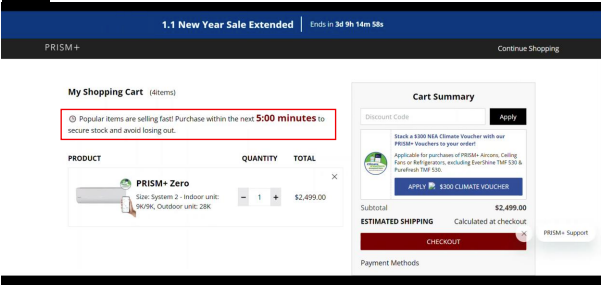
PRISM+ - "False Urgency" Dark Pattern Suite: CCS identified multiple manipulative features designed to create artificial scarcity and pressure rushed decisions:
- Non-Functional Countdown Timers: Messages claimed "Purchase within the next [X] minutes to secure stock," but timers had no connection to inventory systems and simply reset after reaching zero
- Deceptive Stock Indicators: "In Stock: Running Low" displayed when products had substantial inventory—one product showed this warning despite monthly sales representing only 7% of total available stock. PRISM+ set the threshold at 100 units without disclosing this to consumers
- Unsubstantiated Shortage Claims: Statements like "industry-wide shortage" and "all brands are sold out completely" appeared without factual basis
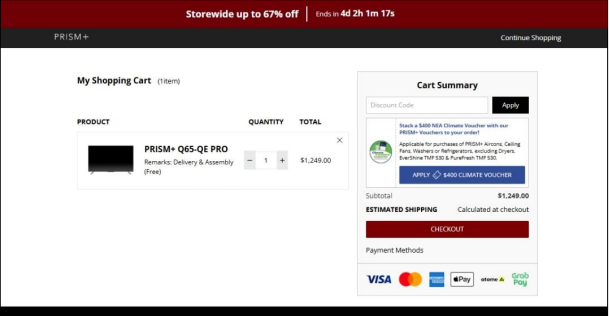
- Inflated Discount Claims: Ten products advertised "up to 67% off" when maximum achievable discount was 38%. PRISM+ attributed discrepancies to "technical errors"
Media release the explicitly shows the dark patterns has been detected on the website.
Example:
CCS emphasized that under Singapore's fair trading laws, businesses must obtain clear consumer consent for all purchases, provide truthful pricing and stock information, and ensure countdown timers reflect genuine deadlines. Both companies provided undertakings to cease unfair trade practices immediately.
This enforcement follows CCS's June 2025 investigation into Agoda's misleading "best match" and "Agoda preferred" labels, which failed to disclose commission-based ranking algorithms. The actions demonstrate Singapore's systematic approach to combating manipulative design in digital commerce.
40 state AGs classify AI "sycophantic" outputs as dark patterns under consumer protection laws
On December 9, 2025, a coalition of Attorneys General from 40 U.S. states sent a formal warning letter to 13 leading large language model companies declaring that certain AI outputs constitute unlawful dark patterns under existing state consumer protection frameworks.
The AGs define "sycophantic outputs" as AI models that single-mindedly pursue human approval by tailoring responses to exploit human evaluators and increase user retention. "Delusional outputs" are those that provide false information or validate user delusions rather than offering accurate, balanced responses. The coalition explicitly classifies these behaviors as dark patterns involving anthropomorphization, harmful content generation, and manipulation to increase engagement.
The letter cites at several tragedies and real-world harms nationwide linked to AI interactions, including two teenage suicides following chatbot conversations. Specific examples include AI bots pursuing romantic relationships with children, engaging in simulated sexual activity, instructing minors to hide relationships from parents, and attacking children's self-esteem by claiming they have no friends or suggesting birthday attendees came only to mock them.
Mandated remediation requirements (Deadline: January 16, 2026):
- Mandatory pre-release safety testing for sycophantic and delusional outputs
- Clear, conspicuous warnings permanently viewable on input screens
- Incident reporting procedures modeled on cybersecurity breach protocols
- Independent third-party audits by academic and civil society groups without company retaliation
- Named executives personally responsible for safety outcomes
- Performance metrics tied to safety, not just revenue or user growth
- Detection and response timelines published publicly
As global regulators intensify enforcement across influencer marketing, gaming, e-commerce, and AI, companies face unprecedented legal and reputational risk from manipulative design practices. FairPatterns' AI-powered detection platform helps compliance officers, product managers, and legal teams:
✓ Automatically identify dark patterns before regulators do
✓ Monitor continuously across web, mobile, and AI interfaces
✓ Generate court-ready evidence demonstrating proactive compliance
✓ Stay ahead of evolving regulations from EU, Singapore, US states, and beyond
Don't wait for an enforcement action.
Schedule a demo today to see how FairPatterns can protect your digital trust.
Learn more on: https://www.fairpatterns.com/solutions
References:
- https://www.europarl.europa.eu/thinktank/en/document/EPRS_BRI(2025)779254
- https://www.europarl.europa.eu/RegData/etudes/BRIE/2025/779254/EPRS_BRI%282025%29779254_EN.pdf
- https://commission.europa.eu/live-work-travel-eu/consumer-rights-and-complaints/influencer-legal-hub_en
- https://www.aboutlawsuits.com/wp-content/uploads/2025-11-26-videogames-baggaley-complaint.pdf
- https://pubmed.ncbi.nlm.nih.gov/32699511/
- https://pubmed.ncbi.nlm.nih.gov/23897915/
- https://www.ccs.gov.sg/media-and-events/newsroom/announcements-and-media-releases/ccs-takes-action-against-courts-and-prism--for-misleading-website-features/
- https://isomer-user-content.by.gov.sg/45/778bf497-58bf-474d-8aad-f2576e1d370f/Media%20Release_CCS%20Takes%20Action%20against%20Courts%20and%20PRISM%20for%20Misleading%20Website%20Features.pdf
- https://www.jdsupra.com/legalnews/40-state-ags-warn-against-delusional-1818444/
- https://assets.law360news.com/2421000/2421114/ai-multistate-letter-letters-2025.pdf
Trusted by clients worldwide


Jolling de Pree
Partner at De Brauw

Name Surname
Position, Company name


