
A Q&A with Marie Potel-Saville on Dark Patterns and Fair Design
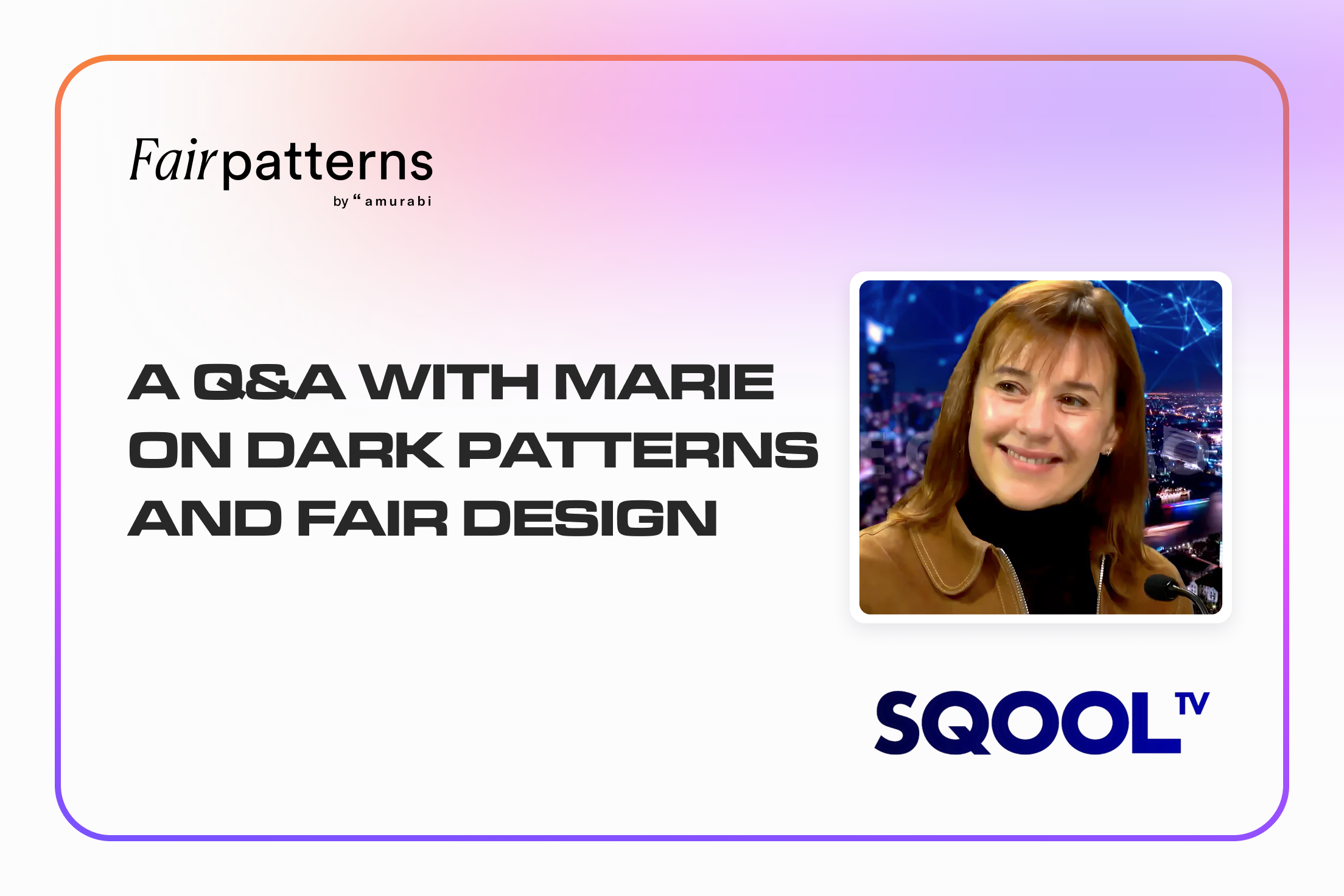
In this short Q&A, Marie Potel-Saville, CEO of FairPatterns, shares key reflections on dark patterns, digital fairness, and why responsibility in design cannot wait. Drawing from real-world experience, she explains how manipulative interfaces undermine trust and why fair design is becoming essential for sustainable digital products.
Below is the full transcript of the video, provided in both English and French to ensure accessibility and allow everyone to engage with the content in their preferred language.
Transcript – English
Marie Potel-Saville, Co-founder and CEO of Fair Patterns
My name is Marie Potel-Saville, and I am the co-founder and CEO of Fair Patterns.
Today, designs created to manipulate users are almost everywhere online. We encounter them on websites, mobile apps, and social media platforms.
Here are a few very concrete examples.
Often, the buttons designed to make you accept an offer, agree to cookies, or share your location are much more visible, more colorful, and larger. By contrast, the option to refuse is hidden behind a small grey link or requires several clicks.
Whenever there is a single action to subscribe or start a free trial, but many steps required to unsubscribe, we are clearly dealing with a form of manipulation.
Another very common example is the message saying “45 people are viewing this room at the same time as you.” Coincidentally, this information is most often completely false. And even when it is true, it usually refers to different dates than the ones you are actually interested in, making the message entirely irrelevant.
-----------------------------------------------------------------------------------------------
Transcription – Français
Marie Potel-Saville, cofondatrice et présidente de Fair Patterns
Je suis Marie Potel-Saville, cofondatrice et présidente de Fair Patterns.
Des designs pensés pour nous manipuler, il y en a aujourd’hui à peu près partout en ligne. On les retrouve sur les sites web, les applications, et les réseaux sociaux.
Quelques exemples très concrets.
On voit souvent des boutons beaucoup plus visibles, plus colorés et plus grands pour accepter l’offre qu’on vous pousse, accepter les cookies ou partager votre géolocalisation. À l’inverse, le refus est relégué à un petit lien gris, peu visible, ou nécessite plusieurs clics.
Dès lors qu’il y a une seule action pour s’abonner ou activer un essai gratuit, mais de nombreuses étapes pour se désabonner, on est clairement face à une forme de manipulation.
Autre exemple très courant, les messages de type « 45 personnes regardent cette chambre en même temps que vous ». Comme par hasard, c’est très souvent complètement faux. Et même lorsque ce serait vrai, il s’agit généralement d’autres dates que celles qui vous intéressent réellement, ce qui rend l’information totalement inutile.
-----------------------------------------------------------------------------------------------
As regulatory frameworks evolve and digital products grow more complex, conversations like this help bring clarity back to the essentials: respect for users, transparency, and accountability by design. Watch the full Q&A to better understand how fair patterns can replace dark patterns and support more trustworthy digital experiences.
Trusted by clients worldwide


Jolling de Pree
Partner at De Brauw

Name Surname
Position, Company name


